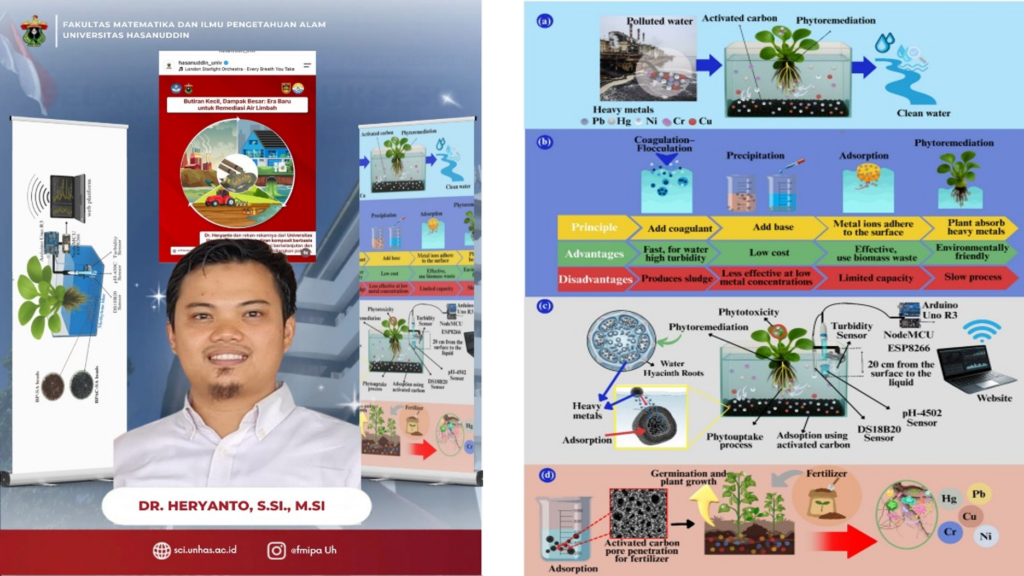
Makassar, 30 September 2026 – Dr. Heryanto, S.Si., M.Si., a physics lecturer at the Faculty of Mathematics and Natural Sciences (FMIPA) at Hasanuddin University, along with his team, has successfully developed an innovative approach to treating contaminated water using environmentally friendly materials. The research combines activated carbon derived from banana peels, water hyacinth (Eichhornia crassipes), and Internet of Things (IoT) technology. This innovation was developed as an alternative to address water pollution while also improving the utilization of agricultural waste.
In one study, banana peel waste was processed into activated carbon and then combined with sodium alginate to form an adsorbent material. This material was combined with water hyacinth to help reduce the methylene blue content in water. The results showed that the combined system was able to remove up to approximately 92.6 percent of the methylene blue. The system also demonstrated stability when used over several treatment cycles.
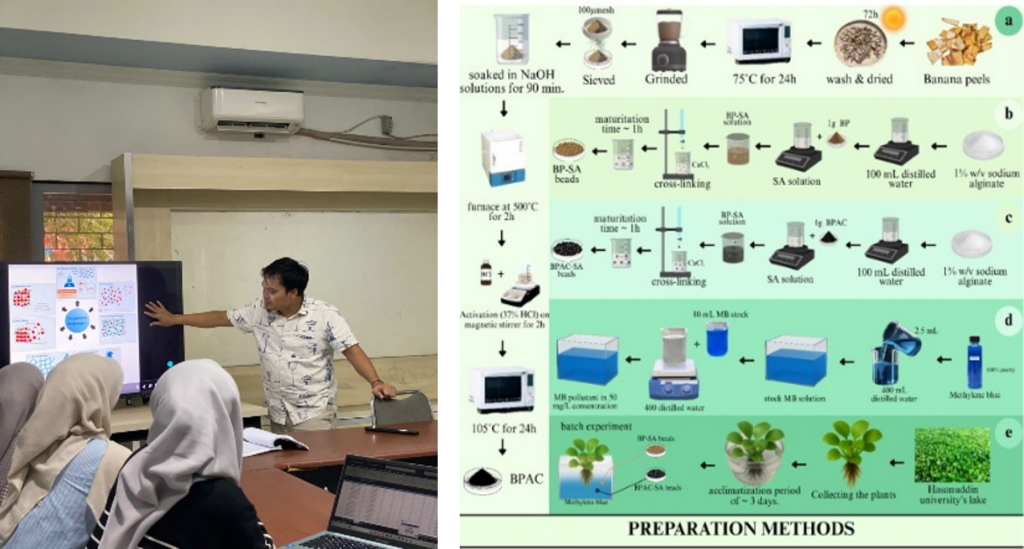
The research goes beyond the use of natural materials; it also integrates IoT technology to monitor processing conditions in real time. Parameters such as pH, temperature, and turbidity can be monitored, allowing for quicker detection of changes in conditions during the treatment process. This integration of digital technology is a key component in the development of a more quantifiable water treatment system.
A similar concept was subsequently expanded upon through a study on the use of activated carbon and water hyacinth to treat water contaminated with heavy metals. The study showed that activated carbon can rapidly capture pollutants, while water hyacinth can aid the treatment process through phytoremediation. The combination of the two is considered to have the potential to overcome the limitations that arise when each method is used separately.
Through these two studies, Dr. Heryanto and his team demonstrated that water treatment can be developed by combining waste-based materials, the natural capabilities of plants, and digital technology. This approach not only focuses on reducing pollutants but also opens up opportunities for more valuable utilization of agricultural waste and biomass. Moving forward, the concept of integrating adsorption, phytoremediation, and IoT could become a key direction for developing more efficient and sustainable water treatment technologies.
#MIPABerintegritas #MIPABerkualitas